Statement & Biography
HyungJoo Kim
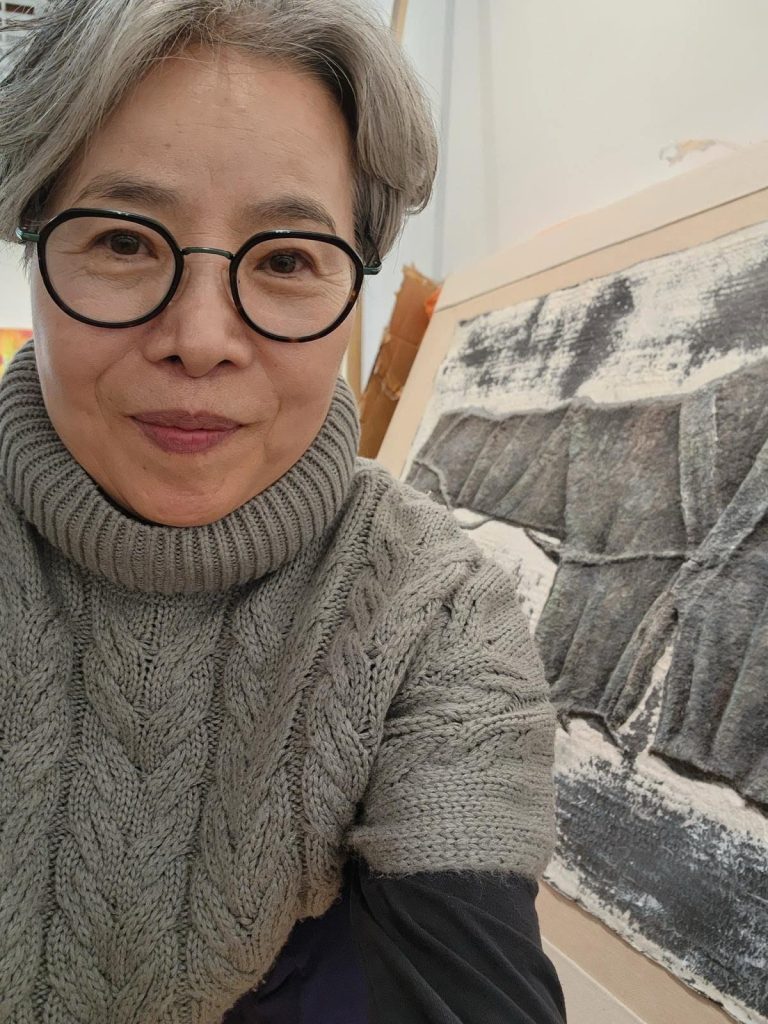
Each work begins with the scale of a coat-like form and the drawing that lives on its surface. After graduating from Hongik University and completing graduate studies, I devoted myself to refining a personal method with steady, almost ritual focus. The paper dolls I played with as a child remained with me like old friends. During a long recovery after typhoid, I learned beside my mother and found genuine comfort in simply being able to touch paper. When I returned to paper through my university classes, it felt like reuniting with someone I had missed for a long time. My Dakjong practice demands time, ingenuity, and uncompromising cleanliness. Through repeated cycles of boiling, washing, and filtering, the material is prepared and shaped with carved wooden molds until it becomes a self-supporting paper form. The work is completed with the concentrated intensity of a performance: a sustained state of attention built through perseverance, tapping, and an unshakable hand. There is no margin for error in a material made only by water, sunlight, and human hands. Paper records every decision. In that honesty, discipline becomes a way of making, and patience becomes the path to precision.
Born in 1959 in Masan, South Korea, HyungJoo Kim holds a B.F.A. and an M.F.A. in Fiber Art from Hongik University. She has served as a Visiting Professor at Michigan State University and North Park University, where she also taught as an Artist-in-Residence. Kim has exhibited internationally, including at the Chicago Cultural Center and the MIA Art Fair, with project sponsorships from major corporations such as Samsung.
"My art is about 'Communication.' My inner voice communicates with basic human needs... reminiscent of bamboo swaying in the wind."
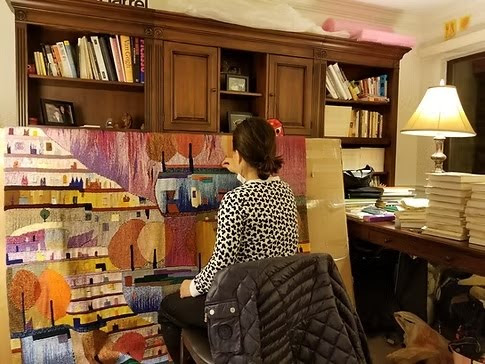
"My work is deeply influenced by my personal struggle overcoming illness and the devoted love of my mother. Specifically, the 'heartbeat' and the connection between mother and child are central themes in my practice. Through Hanji, weaving, and mixed media, I visualize the 'Spirit of Korea'-Harmony, Humanity, and Freedom."
A Turning Point in America
In Detroit, at the Pezaiski Gallery of the Ford Foundation, I presented a commemorative exhibition marking the fiftieth anniversary of the Korean War armistice. The exhibition was supported by Dr. Hyun Bong Hak, the Mayor of Dearborn, and members of the Korean community in Michigan, many of whom attended the opening. Korean American official Shin-ae Jeon and Mrs. Nancy also visited from the White House. In Chicago, the cultural affairs consul and Yuk Gil-won, an adviser to the Hankook Ilbo, traveled more than five hours to report on the exhibition.
Retired American generals who had served in the Korean War took the lead at the opening. They observed a moment of silence, fired a ceremonial salute, and planted a commemorative tree in honor of the twenty-seven American soldiers who died during the war. Around that time, Professor Jeon In-ho, now a professor at Chung-Ang University, had just returned from studying in France and was working as a part-time lecturer. He joined the Spirit of Korea exhibition team as both manager and planner.
Although the exhibition received extraordinary publicity and filled the newspapers day after day, it was not covered by American art journals. After another exhibition at the James Tygerman Gallery, I moved to Chicago in July 2004 as an invited professor at North Park University, and from that point exhibitions continued one after another.
Even while I continued to exhibit, life as a foreigner stranded alone on an island no one knew also continued. As time passed and uncertainty deepened, I clung more fiercely to my work. I had to do something. Through the act of making art, I found the strength to search for my essential self. With my 2006 solo exhibition at the Chicago Cultural Center as a turning point, the works I loved like my own children began to move onto a wider world stage. The response was astonishing. NBC Chicago came to cover the show, and the news was broadcast on television.